
The United States is in an era of rising electricity demand, driven by artificial intelligence and data centers, advanced manufacturing, and electrification.
The challenge now before policymakers is not simply meeting that demand but doing so in a way that preserves reliability and protects consumers from unnecessary costs – navigating uncertainty around how much, how fast, and where energy load will materialize.
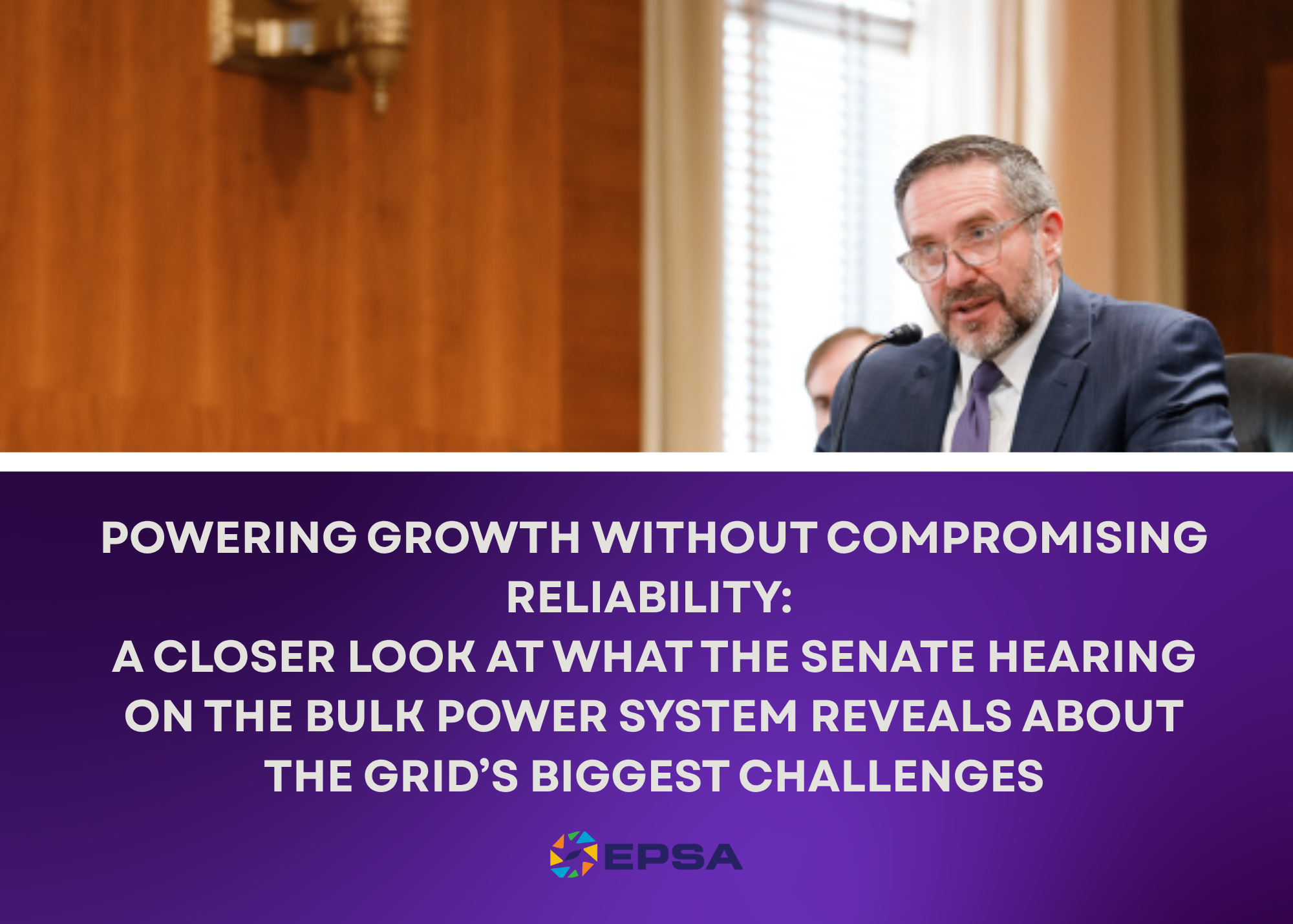
These questions, and the risks of getting them wrong, were at the center of the recent Senate Energy & Natural Resources Committee hearing on the State of the Bulk Power System, which featured testimony and insights from EPSA President and CEO Todd Snitchler.
Competitive Markets: A Framework for Managing Risk
As we explored in an earlier blog post, EPSA’s message to Congress underscores that the United States faces a growing need to lift up competitive wholesale electricity markets as they remain the most effective tool to deliver reliable, affordable power, especially in periods of uncertainty.
Representing approximately 225,000 megawatts of generation capacity across competitive U.S. markets, EPSA members operate in an environment where investment risk is borne by investors, not consumers. This distinction especially matters as consumers are already feeling the rising costs from investment decisions by monopoly utilities, a problem that will only get worse if monopolies are allowed to build generation without competition.
Competitive markets create a barrier between shareholders and ratepayers. For EPSA’s members, developers build generation based on price signals and in the event those investments turn out to be unnecessary, these costs are not reflected on your energy bill but rather the shareholders of the company who made the decisions.
Time and again, this structure has proven its value. For example, when capacity prices rose in the PJM Interconnection market, signaling a need for more supply, competitive providers responded. Since mid-2024, more than 12 gigawatts of additional capacity have been announced through new builds, uprates, and delayed retirements.
The Real Risk: Getting Demand Wrong
The central theme for anyone acting within today’s energy landscape is uncertainty. Crucial questions on the amount of electricity we need and the timeline for demand to materialize have vast ranges of varied answers. Load forecasts are shifting rapidly. As Snitchler noted during the hearing, projections can swing dramatically when speculative projects are filtered out or when developers are required to make financial commitments. In one case, a projected 30 GW data center load dropped to just 5.7 GW after more rigorous scrutiny.
This volatility creates two major risks:
- Underbuilding, which threatens reliability
- Overbuilding, which drives unnecessary costs
Accurate, disciplined load forecasting is foundational. Without it, the industry risks misallocating billions in capital, and consumers ultimately pay the price.
Permitting Reform: The Most Immediate Opportunity
While markets are responding and investment interest is strong, a major bottleneck that prevents more capacity from coming online is permitting.
across the country, many projects and thousands of megawatts of generation have already cleared interconnection queues but are stalled in permitting processes. In PJM Interconnection alone, more than 70 GW of approved projects are not yet under construction.
The challenge is no longer just getting projects into the queue; it’s getting them built and online. Permitting uncertainty, supply chain and workforce constraints, and state policies are all contributing to the problem.
At the same time, there has been meaningful progress on interconnection reform. Snitchler noted that all regions have followed FERC direction to study and improve their queue processes, and those efforts will need to continue and accelerate. He pointed to emerging solutions, including a partnership between Google and PJM to use AI to help speed queues and a recent FERC order approving a Southwest Power Pool proposal which takes a more innovative approach to evaluate interconnection alongside transmission planning, as examples of innovative approaches gaining traction. “I think thoughts and approaches like that are going to be incredibly helpful,” he said.
Still, even as interconnection improves, permitting reform remains the single most impactful action Congress can take to unlock supply and improve both reliability and affordability. As Snitchler emphasized, this is not about lowering standards, it’s about creating a predictable process that allows critical infrastructure to move forward.
Consumers Must Come First
Throughout the hearing, EPSA returned to a core principle: protecting consumers.
Recent analysis shows that rising electricity bills are not primarily driven by generation costs. Instead, increases are largely tied to spending on transmission and distribution infrastructure, costs that are typically passed directly to ratepayers through regulated frameworks. This proves evident that how investments are made matters just as much as what investments are made.
Competitive markets shield consumers from the risk of inefficient generation investment. Policies that shift that risk back onto ratepayers, such as returning to utility-owned generation with guaranteed returns, reverses decades of progress.
The Bottom Line
As Snitchler conveyed to the Committee, the goal is not just to build more, but to build smarter in the face of uncertainty. By leveraging competitive markets, encouraging innovation, and removing unnecessary barriers, the U.S. can meet rising demand while preserving the reliability and affordability that consumers depend on. There is no single solution, but there is a proven framework through competitive markets, which have consistently risen to meet these challenges when they are supported and encouraged by stakeholders.
What Comes Next
The discussion at the hearing made clear that the path forward will require coordinated action across markets, policy, and planning.
Several priorities stand out:
- Improving load forecasting practices
Policymakers and system operators will need to ensure that demand projections are grounded in realistic assumptions and backed by financial commitments—not speculative inquiries.
- Advancing permitting reform
With tens of gigawatts of approved projects stalled, streamlining permitting processes will be critical to translating investment into operating capacity.
- Preserving competitive market structures
As demand grows, maintaining frameworks that allocate risk to investors—not consumers—will be essential to keeping costs in check.
- Aligning large-load growth with system needs
As data centers and other large users expand, ensuring these new loads are integrated without compromising system reliability will be essential. FERC, PJM Interconnection, and other grid operators are actively developing frameworks to support this outcome.
