
What PJM’s Interconnection Queue Means for the Future of Power Supply
Top takeaways:
- More than 800 new power projects applied to connect to the grid with roughly 220 gigawatts of potential capacity signaling a strong market response to rising electricity demand.
- A diverse mix of resources—including natural gas, storage, renewables, and emerging nuclear fusion technology—highlights both innovation and the continued need for reliable, on-demand power.
- Bringing new generation to construction relies on clearing permitting hurdles, supply chain delays, and workforce challenges faced by developers across all regions and market models.
As electricity demand rises across the U.S., project applications for what is known as the interconnection queue are one of the first steps to getting new power supply online.
The interconnection queue is the process through which developers apply for approval to connect new power plants to the grid. Without clearing this step, no project, regardless of technology, can deliver electricity to homes, businesses, or large energy users.
In much of the Mid-Atlantic and Midwest, this process is managed by PJM Interconnection, the regional grid operator responsible for maintaining reliability for 67 million people across 13 states and the District of Columbia. Reflecting nationwide – and even global – trends, PJM expects power demand to grow significantly in the coming years, with data centers playing a major role.
The latest results offer an early, market-based indicator of how the power sector is responding to rapidly growing demand, and where policy attention may be needed next.
PJM’s interim CEO David Mills emphasized that “These numbers represent significant interest from developers resulting from strong market signals, and our reformed process is designed to prioritize viable projects that can move to construction and operations with greater speed and certainty.”
A Surge in Applications Reflects Rising Demand
More than 800 projects—totaling roughly 220 gigawatts of potential capacity—have applied to connect under PJM’s newly reformed process.
This level of interest reflects strong market signals, driven by factors policymakers are already tracking closely: the rapid growth of data centers, increased electrification, and expanding domestic manufacturing.
What’s in the Queue
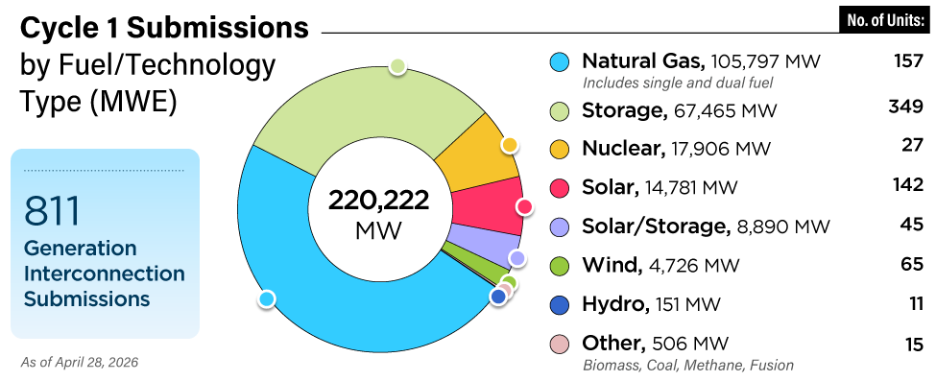
The applications include a broad mix of resources: natural gas, energy storage, renewables, nuclear, and even a first-ever fusion project.
This diversity underscores a key point: competitive power markets are producing a wide range of commercially-viable potential solutions to hyperscalers, other customers, and grid operators to meet demand.
At the same time, the composition of the queue highlights an immediate reliability need. Natural gas (105.8 GW) and storage (66.5 GW) make up a significant share of proposed capacity, reflecting the importance of dispatchable resources—power sources that can run on demand—to support grid reliability and 24/7 energy needs, particularly from large users like data centers. Paired with renewables, storage and natural gas help ensure power is available when and where it’s needed.
What’s Needed to Move to Construction
PJM’s updated process is designed to address a major bottleneck. The shift to a “first-ready, first-served” system prioritizes projects that are more likely to move forward, aiming to reduce delays and improve certainty.
This is a notable step toward filtering out speculative projects and improving how quickly new supply can be evaluated and approved.
But clearing the interconnection queue does not guarantee a project will be built. Many projects that receive approval still face significant hurdles, including state and local permitting timelines, supply chain delays, equipment backlogs, and workforce constraints. These issues are increasingly central to conversations at the federal and state level.
These barriers are faced by competitive developers and vertically integrated utilities alike – no one market model is better suited to bring resources online more speedily. Addressing these barriers will help translate strong developer interest and private capital into real-world infrastructure that supports reliability and economic growth.
From Queue to Construction: the Policy Gap
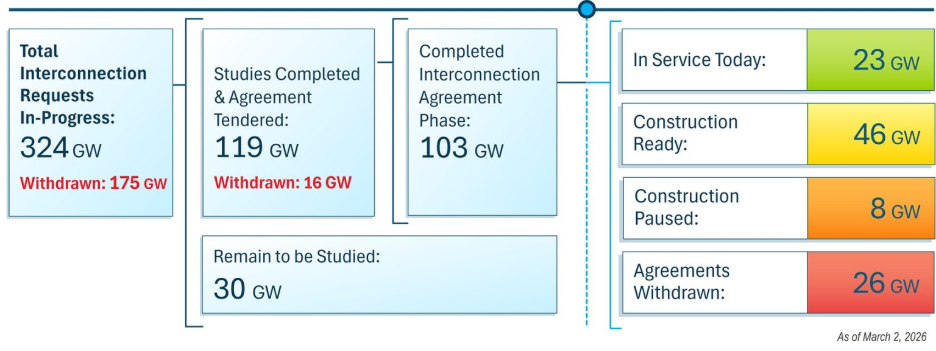
Historically, only a portion of projects in the queue ultimately reach operation. Since 2020, PJM has processed more than 300 GW of projects, resulting in 103 GW of resources with signed interconnection agreements. But approximately 70 GW of those approved projects either withdrew their agreements, paused construction, or are otherwise delayed due to factors beyond the market’s control.
The gap between projects proposed and projects built is where policy decisions can have the greatest impact. EPSA continues to urge action on comprehensive permitting reform legislation, but has highlighted our support for promising areas for consensus such as the GRID Act sponsored by Ohio Representative Troy Balderson.
The strong response to PJM’s queue reopening shows that private investment is ready to support new generation. Ensuring those projects move forward will depend on aligning interconnection improvements with progress on permitting, infrastructure, and workforce development.
Companies Are Innovating
EPSA member companies have shown innovative approaches to strike agreements with hyperscalers, turbine manufacturers, and construction firms to build new generation and expand existing power plant capacity, and to shore up access to both critical equipment like natural gas turbines and the workforce needed to bring new plants online in the timeframe required. Partnerships with AI companies like NVIDIA are also working to increase data center efficiency and flexibility to ramp up or down as grid reliability requires.
EPSA members have announced more than 12 GW of new capacity in PJM since mid-2024 through new builds, uprates, and delayed power plant retirements.
What’s Next
Not all of the projects submitting applications will eventually secure interconnection agreements and move to development. With the closing of the application window on April 27, PJM now begins a validation phase to confirm that projects have met the required technical and financial information to advance the process. Projects will be reviewed in what is designed to be a one- to two-year process, depending on the individual project’s impact.
The Bottom Line
While most of the increase in electricity costs over the past decade has been driven by utility spending on transmission and distribution infrastructure—not power generation or capacity market prices—bringing new generation online remains essential to addressing supply constraints and managing long-term consumer costs. Meeting rising data center demand through competitive electricity markets and private sector agreements will help ensure that American households and consumers don’t have to pay more than necessary for infrastructure growth.
The strong response to PJM’s queue reopening shows the market is stepping up, with a large and diverse set of proposed projects available to meet rising demand from hyperscalers and other energy users. Within that mix, reliable, on-demand resources will continue to play a critical role in maintaining grid reliability in the near term.
How much of this proposed supply ultimately comes online will depend on policy choices and addressing other challenges beyond the queue.
As demand growth accelerates, the speed at which new generation can move from application to operation will shape the reliability and affordability of electricity and America’s AI leadership and overall economic competitiveness.
